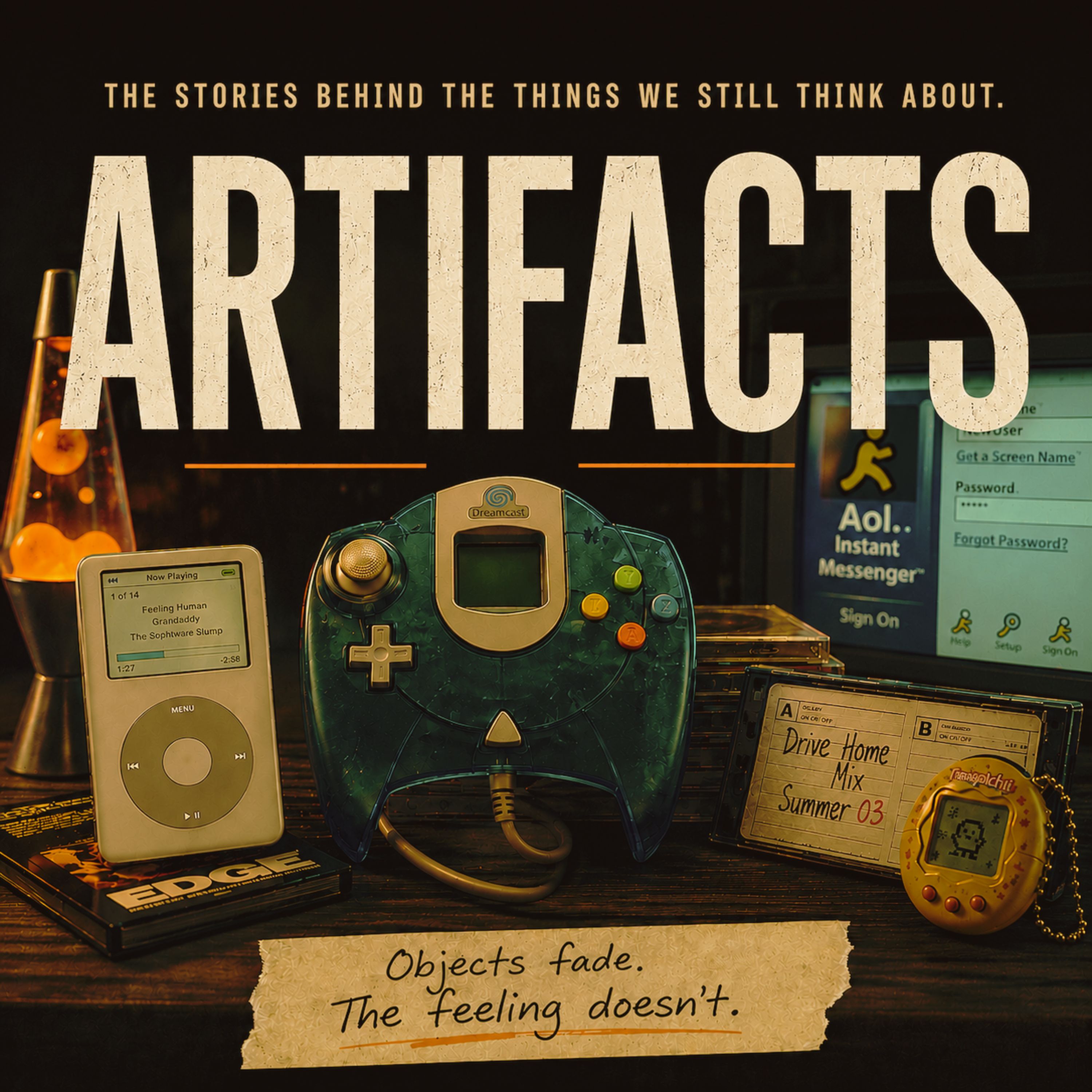

The Dreamcast Wasn’t Supposed to Matter This Much
Enjoying the show? Support it here.
The Dreamcast failed. At least, that’s the official version of the story.
Released on 9/9/99, Sega’s final console lasted only a few short years before disappearing from store shelves forever. But decades later, people still talk about the Dreamcast with a kind of emotional reverence usually reserved for much bigger success stories.
So why does it still matter so much?
In the first episode of Artifacts, Danny Brown explores how the Dreamcast became more than just a game console - it became a symbol of optimism, experimentation, creativity, and a version of the future that never fully arrived.
From Jet Set Radio and Crazy Taxi to online gaming over dial-up and the strange emotional power of failed technology, this episode explores why some artifacts stay with us long after they disappear.
Because sometimes the objects fade.
But the feeling doesn’t.
Get Involved
If you enjoy Artifacts, you can support it with either a one-off tip, or become a monthly Archivist.
No commitment - just a simple way to say thanks. Show your support here.
If you enjoy the show, I'd love for you to leave a rating or review on your favourite podcast app!
And please let your friends know they can listen for free on Apple Podcasts or their preferred podcast app, or online at Artifacts Podcast.
Products I Use for Artifacts
Note: these may contain affiliate links, so I get a small percentage of any product you buy when using my link.
My equipment:
- RODE NT1-A large diaphragm condenser mic
- Rodecaster Pro II audio production studio
- Sony MDR-7506 Studio Monitor Headphones
- Elgato Wave Mic Arm Low Profile
Recommended resources:
Transcript
Speaker0: I'm Danny Brown, and you're listening to Artifacts, a storytelling podcast about
Speaker:Speaker0: technology, internet culture, media, and the feelings we still attach to them.
Speaker:Speaker0: Because sometimes the objects fade, but the feeling doesn't.
Speaker:Speaker0: The Dreamcast failed. At least that's the official version of the story.
Speaker:Speaker0: Launched in North America on September 9th, 1999, the Dreamcast was gaming giant Sega last console.
Speaker:Speaker0: 9-9-99 Which feels like the most Dreamcast launch date imaginable.
Speaker:Speaker0: Big, confident, almost weirdly optimistic. And for a little while, it worked.
Speaker:Speaker0: People, including me, loved this thing. Critics loved it.
Speaker:Speaker0: Developers loved it. and gamers still talk about it with the kind of reverence
Speaker:Speaker0: that usually gets reserved for massively successful consoles.
Speaker:Speaker0: Except the Dreamcast wasn't massively successful.
Speaker:Speaker0: By 2001, Sega was out of the console business entirely.
Speaker:Speaker0: The PlayStation 2 had arrived and the market shifted. And the Dreamcast?
Speaker:Speaker0: Well, that became another piece of discontinued hardware sitting in closets in thrift stores.
Speaker:Speaker0: At least, that's how the story should have ended, but it didn't.
Speaker:Speaker0: Because people don't talk about the Dreamcast like it was a failed console.
Speaker:Speaker0: They talk about it like it was a lost future.
Speaker:Speaker0: And normally, most failed tech just disappears.
Speaker:Speaker0: After all, nobody forms emotional support groups for forgotten printers.
Speaker:Speaker0: Nobody gets misty-eyed about outdated routers. But the Dreamcast,
Speaker:Speaker0: people still love this thing, even 25 years later.
Speaker:Speaker0: And personally, I don't think it's real about the hardware. I think it's about
Speaker:Speaker0: what the Dreamcast represented.
Speaker:Speaker0: The late 90s were a strange moment for gaming. A strange but cool moment.
Speaker:Speaker0: Everything still felt experimental. The rules weren't locked in yet,
Speaker:Speaker0: and nobody had fully figured out what a modern video game was supposed to be.
Speaker:Speaker0: And Sega, especially Sega, well, they operated with this chaotic arcade energy.
Speaker:Speaker0: Nintendo felt kind of polished, Sony felt cool. But Sega?
Speaker:Speaker0: Sega felt like somebody running into a room with six wild ideas and too much caffeine.
Speaker:Speaker0: And somehow, that energy made a Dreamcast feel alive.
Speaker:Speaker0: After all, this was the console that gave us Crazy Taxi. A game where your entire
Speaker:Speaker0: job was basically driving like a complete maniac while punk music screamed at
Speaker:Speaker0: you. It gave us Jet Set Radio.
Speaker:Speaker0: Still one of the most visually stylish games ever made.
Speaker:Speaker0: Cell sharing before most people even knew what cell sharing was.
Speaker:Speaker0: It gave us Shenmue, which was simultaneously brilliant, awkward,
Speaker:Speaker0: ambitious, slow, groundbreaking and kind of ridiculous.
Speaker:Speaker0: You could work a forklift job, you could feed a cat, you could wander around
Speaker:Speaker0: opening drawers in your home.
Speaker:Speaker0: The game cared about tiny details before open world gameplay became standard in games.
Speaker:Speaker0: And then it was Phantasy Star Online which genuinely felt futuristic at the time.
Speaker:Speaker0: Online console gaming at home in 2000 over dial-up.
Speaker:Speaker0: That felt like magic, actual magic the Dreamcast
Speaker:Speaker0: even looked optimistic the little orange swirl the clean white shell the weird
Speaker:Speaker0: memory card with its own tiny screen the VMU or visual memory unit felt like
Speaker:Speaker0: something from the future and maybe that's part of why the console stuck emotionally
Speaker:Speaker0: the Dreamcast wasn't just selling games it was selling possibility,
Speaker:Speaker0: and here's the thing I think the Dreamcast failure is part of why people still feel so attached to it.
Speaker:Speaker0: Because when something succeeds on a massive scale, it eventually stops belonging to individuals.
Speaker:Speaker0: Instead, it becomes infrastructure. The PlayStation 2, for example,
Speaker:Speaker0: sold over 150 million units, which is pretty incredible.
Speaker:Speaker0: But the Dreamcast? Well, the Dreamcast feels personal.
Speaker:Speaker0: On-in-one felt like being part of a weird little club. And if you loved it,
Speaker:Speaker0: you spent years explaining to people why they were wrong about it.
Speaker:Speaker0: That creates emotional investment. It turns fandom into identity.
Speaker:Speaker0: And as humans, we do this a lot. We become deeply attached to flawed things,
Speaker:Speaker0: failed things, underdog things.
Speaker:Speaker0: Because loving something imperfect says something about us. It says we value
Speaker:Speaker0: experimentation, risk, personality.
Speaker:Speaker0: The Dreamcast wasn't polished into corporate perfection. It felt human,
Speaker:Speaker0: messy, creative and ambitious.
Speaker:Speaker0: And maybe people sensed that even at the time because Sega was taking swings,
Speaker:Speaker0: some worked, some absolutely did not but the energy felt different from modern gaming.
Speaker:Speaker0: Today, major games on their own can cost hundreds of millions of dollars which
Speaker:Speaker0: means risk is harder to write off.
Speaker:Speaker0: Experimentation becomes dangerous and everything starts getting filtered through
Speaker:Speaker0: market research and franchise strategy.
Speaker:Speaker0: But the Dreamcast era, well that felt unpredictable.
Speaker:Speaker0: Developers were discovering the future in real time, and players got to come along for the ride.
Speaker:Speaker0: One of my favourite things online is watching people talk about old technology.
Speaker:Speaker0: Because they almost never talk about specs, not really. They talk about moments,
Speaker:Speaker0: feelings, who they were at the time.
Speaker:Speaker0: People remember late night gaming sessions, discovering weird games at rental
Speaker:Speaker0: stores, hearing crazy taxi music blasting through tiny CRT TV speakers,
Speaker:Speaker0: staying up way too late trying to figure out Shenmue.
Speaker:Speaker0: The artefact becomes attached to memory, and memory often smooths rough edges.
Speaker:Speaker0: Because nostalgia isn't usually about accuracy, it's about emotional texture.
Speaker:Speaker0: And the Dreamcast carries a specific emotional texture for a lot of people.
Speaker:Speaker0: Optimism, weirdness, possibility.
Speaker:Speaker0: A moment before gaming became hyper-standardised, before every online conversation
Speaker:Speaker0: became platform-driven, and before everything became content.
Speaker:Speaker0: The Dreamcast existed in its little transitional pocket of time where the future
Speaker:Speaker0: still felt exciting instead of exhausting.
Speaker:Speaker0: And maybe that's a real thing people miss. Not the console, the feeling.
Speaker:Speaker0: The Dreamcast wasn't the best-selling console. It wasn't the most powerful.
Speaker:Speaker0: It didn't win the generation.
Speaker:Speaker0: But, decades later, people still talk about it like it mattered.
Speaker:Speaker0: And maybe that's because success and impact aren't always the same thing.
Speaker:Speaker0: Some things leave a mark precisely because they disappear. Because they represent
Speaker:Speaker0: a version of the future that never fully arrived.
Speaker:Speaker0: And maybe part of growing older is realising we spend a surprising amount of
Speaker:Speaker0: time looking for those feelings again.
Speaker:Speaker0: Not necessarily the objects themselves, but the optimism attached to them.
Speaker:Speaker0: The possibility, the weirdness, and the sense that creativity could still surprise us.
Speaker:Speaker0: I'm Danny Brown, and this is Artifacts.
Speaker:Speaker0: Thanks for listening to Artifacts. If this episode reminded you of a memory,
Speaker:Speaker0: a feeling, or a piece of the internet you thought had disappeared,
Speaker:Speaker0: you can find more episodes wherever you listen to podcasts or watch the video
Speaker:Speaker0: version on Apple Podcasts, YouTube, and Spotify.
Speaker:Speaker0: And if you'd like to support the show, visit the website for ways to help keep artifacts alive.
Speaker:Speaker0: Until next time, take care of the things that matter to you, even the small ones.